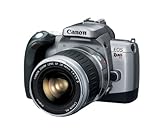
Canon EOS-1Ds is the world's highest-resolution professional digital camera, featuring the first-ever full-frame 35mm sensor with 11.1 million effective pixels. The EOS-1Ds captures astounding detail and color, almost doubling the resolution considered state of the art for a digital SLR camera in the world today (September 2002).
With its extremely high resolution, the EOS-1Ds is designed to meet the needs of a wide range of professional photographers--including studio, commercial, reportage, or fashion photography--who need the ultimate in digital image quality.
Optics
The camera's imaging engine is one of the keys to its exceptional quality. The advanced chip assembles and processes image data captured by the sensor to achieve color accuracy and wide tonal range equivalent to digitally scanned images from conventional film-based cameras.
The EOS-1Ds can capture images at approximately 3 frames per second for a 10-frame burst, even at the highest-quality setting. It also has almost three times as many pixels as the super-fast EOS-1D.
Each of the camera's 45 focusing points is linked directly to Canon's exclusive 21-zone metering system. In addition, the metering system also allows photographers to choose from center weighted, central partial, central spot, focusing-point linked spot, or multispot metering.
The EOS-1Ds features a color matrix function: Five settings provide a choice of two color spaces (standard sRGB or expanded Adobe RGB 1998) and four variations in color characteristics for sRGB. This feature applies to JPEG as well as RAW images, and allows EOS-1Ds image quality to be matched to the requirements of the subject or output device, ranging from four-color offset presses to desktop color Bubble Jet printers.
More Features
- Ability to dial in color temperatures to meet specific lighting conditions
- 10 white balance (WB) modes and WB bracketing provide maximum flexibility and superb color accuracy
- ISO speed bracketing allows you to fix aperture and shutter speeds, yet shoot at three different equivalent film speeds
- Fully compatible with all Canon EF lenses, from ultrawide-angle to super-telephoto
Image Sizes
- RAW: 11.4 MB (4,064 x 2,704 pixels)
- Large/fine: 4.1 MB (4,064 x 2,704 pixels)
- Large/normal: 1.7 MB (4,064 x 2,704 pixels)
- Small/fine: 1.4 MB (,032 x 1,352 pixels)
Storage and Transfer
The EOS-1Ds comes equipped with an IEEE 1394 (FireWire) interface, allowing speedy plug-and-play data communication with computers. For studio photography, new 4.5-meter FireWire cables are available. The camera automatically formats the CF card for either FAT16 or FAT32, according to the maximum storage capacity (FAT 32 is selected for capacity higher than 2 GB).
Images are stored on CompactFlash Type I or II cards (Microdrive compatible). You can create up to 500 subfolders on each CF card with each folder storing up to 9,999 images
Power, Size, and Contents
The camera is powered by a rechargeable NiHM battery pack (included). It measures 6.1 by 6.2 by 3.1 inches and weighs 44.6 ounces. This package includes the EOS-1Ds digital camera body (no lens included), NiMH battery pack (NP-E3), NiMH battery charger (NC-E2), DC coupler kit (DCK-E1), AC adapter (PA-V16), FireWire interface cable (IFC-200D6), neck strap, hand strap, eyecup (EC-II), EOS Digital Solutions CD-ROM, Adobe Photoshop 5.0 LE CD-ROM.
List Price: $8,999.99
Used Price: $1,499.00
Customer Review: Excellent digital system
This is an incredible peice of digital equipment and has more features than the space shuttle. It is most definitely a camera for a younger man however because it's HEAVY, especially with the 70-200 f/28 mounted. I can't imagine lugging around the really LONG lenses. I wore it around my neck for an entire day during a recent shoot and conlcuded that it would be best used in a studio environment on a tripod, or at least a monopod. I have owned several 35mm film cameras and at least seven different digital cameras including Kyocera, Epson, Olympus (2 different models, C2500L & E-10) and finally three Canons: the EOS 1Ds 11.1mp, the Powershot G7 10.1mp, and now the 5D 12.1mp. So far the last two have been the best for my purposes. The quality of course is in the glass, but the artistry is up to the photographer and so far Canon has delivered the very best I could hope for. EOS is an awesome system and the 1DS, aside from the weight is one of the very best.
Customer Review: 11 Mega Pixels is not a random number!
I've recently learned some interesting detail that came from a talented amateur photographer. A friend of mine from work, had done a number of spectacular scenic shots. He thought to enter some of the better ones into a professional competition. While he had a good Cannon digital, (I believe it was a 7 or 8 mp) requirements for digital are 11 mp minimums. While expanding the lower resolution is allowed, it would still fall a bit short (since it only allows a certain percentage). It seems that professional film use cameras, typically deliver the equivalent of 20 mp. The proper film is expensive, and getting it developed is not as easy as taking it to the local Photomat. I know computers and software. My programming exploits placed me for a time at Polaroid ID systems. Polaroid ID, (prior to its sale by the parent company in 2001) produced drivers licenses, and ID card solutions, for more than half the United States, plus several countries. I have a background in video games programming by training. What I can tell you from this is that you need a fast processor to create, and store an image 11 mp in size. Cannon's custom processor seems to be up to the task. My friend told me his current camera used the same processor, and produced the highest resolution shots in about 1/5th of a second. This model does about three continuous shots per second. While not quite film or motion capture speed, it's still good enough not to inhibit your creativity. If photography is a serious hobby, or you are a budding professional, this might just be your camera. Existing professionals will probably make up their own minds on when to jump to digital, and what equipment best meets their needs. Cannons entry here seems reasonable for a quality digital camera. You may see many other cameras pump up their numbers in a race to get the higher resolutions. They seem to be bristling with bells and whistles. There's a not so subtle difference with a professional model like this. That being it has features for professional imaging and the speed of getting to that next high quality shot. The other cameras will raise the bar one day, but for now they are best used by non-professionals. If you compare the camera's specifications, you'll find speed, and feature limitations on those cheaper models. This is not the camera to take on that vacation to the mountains. A good four-mega pixel model will keep all your family photo albums up to date. If however, your vision for looking at the world through the camera's eye extends beyond that, this may be the camera for you. BTW, remember this is a body only, you buy your optics separately, and it's not advisable to go cheap either.
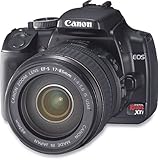 10.1-megapixel effective recording * EF-S 17-85mm f/4-5.6 IS USM lens (35mm equivalent focal length: 28-135mm) * compatible with Canon EF and EF-S lenses, and EX-Series Speedlite flashes * EOS Integrated Cleaning System (for cleaning image sensor) * 2-1/2" high-resolution LCD screen with wide, 160-degree viewing angle *